| "AdaTEST & Cantata Hit The Contractual Mark" |
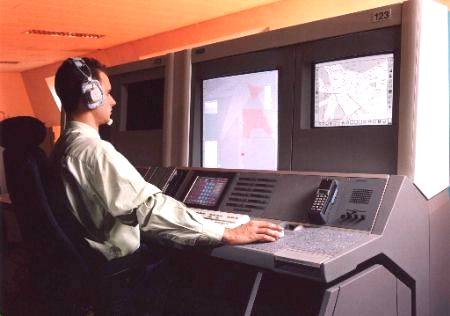 |
| The NERC Air Traffic Operator Console (picture courtesy of Siemens Air Traffic Management Division) |
| Siemens Air Traffic Management, a world-wide centre of excellence within its business field of ATM sensors and systems, is part of the highly successful multinational Siemens group. It is one of the world's leading suppliers of civil air traffic control systems, an area which requires mastery of modern software engineering practices with a distinct focus on use of the Ada programming language. |
| In 1992, the Company formed part of the consortium which was successful in bidding for the contract to supply the New En-Route Centre (NERC) system for the UK Civil Aviation Authority. The purpose of NERC is to replace the London Air Traffic Control Centre with a new facility which will, among other things, permit greater use of air space over southern England. For obvious reasons the system is subject to stringent safety checks, and the system development contract insisted on rigorous software engineering standards. These included a requirement for 100% coverage in software component (unit) testing and the restriction of certain Ada constructs whose use was considered potentially 'unsafe'. |
| Project Requirements |
| This project was a large-scale Ada development, and it fell to the Development Support Department managed by Alan Pitchers, together with the NERC team, to put together a suitable development and testing environment. Key requirements for the environment were that it must assist the teams to do their work efficiently and, at the same time, allow Siemens to meet contractual requirements by producing evidence that development standards are being met. Test facilities are a central part of the tool-set. As part of the on-going software engineering investment programme within the Company, and additionally the need to meet the specific NERC project requirements for testing, an evaluation was undertaken of some of the commercially available Ada testing tools, including IPL's AdaTEST. |
| Evaluation |
| The evaluation was carried out over several months in the first half of 1993, and covered the complete cycle of test generation, test execution, coverage analysis, and regression testing. It also took in the need to carry out static analysis of code to audit the size, complexity and other aspects of the Ada source. At the end of the evaluation, AdaTEST was selected on the grounds that, within the sample of tools considered, it provided the most complete support for the unit testing process. |
| AdaTEST in Action |
| Code for testing started to become available from mid-1994 and at the beginning Siemens used IPL staff on-site to help get the best from AdaTEST. On practical points, unit testing was largely applied using Ada sub-programs as the definition of a 'unit'. This was made possible through extensive use of the Ada 'separate' mechanism, and permitted thorough stubbing of external calls from the units under test. Where testing was applied at the package level, use was made of the 'test_point' mechanism to get at data and procedures hidden within the Ada package bodies. The total volume of code tested is approximately 105,000 lines of Ada source. |
| AdaTEST Experience |
| After nearly two years of use what are the conclusions concerning AdaTEST? Howard Bell, who is Chief Software Engineer for the NERC project, offered his views: "AdaTEST has enabled us to meet all contractual requirements on evidence of unit testing, and we expect further gains when we enter the modification phase. AdaTEST is expected to improve efficiency in introducing updates by running regression tests." The product has also helped them in the smooth running of code inspections by providing reports of source size, complexity and the identification of prohibited Ada constructs, such as the abort statement. Above all, Bell believes, AdaTEST's greatest contribution has been the production of hard evidence relating to the adherence to standards which has saved considerable time and effort on the contract. |
| Lessons |
| Much has been learnt from NERC on the subject of testing Ada and Nick Clark, a software team leader, offers the following practical suggestions to others who may follow: |
| 1. Test planning should be done early, preferably by the designers responsible for specifying code units, specifically to avoid the use of untestable Ada constructs; |
| 2. Where testing is to be performed on a sub-program basis, adopt use of the Ada 'separate' mechanism as standard as this makes testing easier and, more important, less time consuming; |
| 3. Adopt the 'test_point' routine as a standard part of every Ada package specification; |
| 4. On coding practices keep things simple! Avoid fancy code such as nested sub-programs, and avoid practices such as generic instantiations within package specs. |
| Pitchers injects a note of disappointment over the long wait for AdaTEST's new test script generation facilities, but hopes that these will eventually prove worth waiting for and make a contribution to future projects. |
| Cantata |
| Project NERC also involves the production of a large amount of C code. Siemens ordered the Cantata product to assist in the testing of this software, based upon their experiences with AdaTEST at the time, plus the common features that exist between the two tools. The testing of the C is not as advanced as the Ada work, but all the initial indications are favourable. |
| Future Work |
| The successful use of AdaTEST and Cantata on NERC has encouraged Siemens to adopt them for further large air traffic management projects. They are currently being used on systems development work for Eurocontrol and other customers. |
| IPL wishes to thank Siemens Air Traffic Management for permission to report their experiences with AdaTEST and wishes them every success with NERC and their other projects. |


