| "The Evidence Speaks for Itself" |
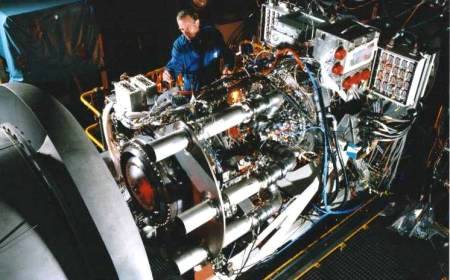 |
| The BR710 Aero-engine, destined for use in regional commercial jet aircraft |
| The case study for this issue of Testing Times comes from the Software Engineering and Assessment Services (SEAS) business of Rolls Royce and Associates (RRA). They serve well as a case study as they have been using both AdaTEST and Cantata over several years, on a variety of projects. This prolonged exposure has given them a very firm view of what software testing is about and its benefits. The conclusion is that, "The evidence speaks for itself"; after several years of solid use SEAS are committed to the value of unit testing as an activity, and the use of IPL tools to support it. |
| RRA is a wholly-owned subsidiary of Rolls-Royce plc and is part of the Rolls-Royce Industrial Power Group. It has been developing high integrity real time software systems for many years and has its origins in submarine nuclear safety systems for the Royal Navy. The SEAS group of RRA is a business unit specialising in high-reliability and high-integrity systems and software, and is actively involved in developing and verifying software both as a prime and subcontractor. SEAS currently employs over 80 engineers and has achieved a steady growth throughout its existence. |
| Def-Stan 00-55 Pilot Project |
| The first contact that SEAS had with AdaTEST started in May 1993 when they were contracted by the UK MoD to perform a study on the (then Interim) Def-Stan 00-55, which relates to software safety. The purpose of the study was to apply the standard to a real project and to make recommendations on how the standard might be improved. Mark Jones was the project engineer assigned to the job. He selected AdaTEST as the most promising tool to help investigate the design and code/test phase of the work on the basis that it offered flexible functionality and multi-platform availability. |
| AdaTEST did indeed prove versatile and gave valuable feedback on both design and code verification. Some of the study's conclusions to which AdaTEST contributed, and which influenced the final form of the standard, included the need for a greater emphasis on testing, specifically coverage analysis and on-target testing. The justification for this was based on the value-for-money contribution of the activities; testing being seen as an important complement to a full formal methods design. |
| BR710 Digital Engine Controller |
| During the Def-Stan 00-55 Pilot Project, SEAS had also become involved with a project to provide Ada testing expertise to a group at RoSEC (Rolls Smiths Engine Controls - a joint venture between Rolls-Royce and Smiths Industries) who were developing an Electronic Engine Controller (EEC) for the BMW-RR BR710 aero-engines. SEAS was able to advise the team on the best and safest ways to test the new Ada code. In May 1994 SEAS were selected by RoSEC to lead the Independent Verification and Validation (IVV) work on the project, for which AdaTEST had already been independently selected as the testing tool. |
| This EEC IVV work involved the testing of approximately 900 Ada procedures, to an extremely high level of reliability. The testing performed by SEAS meets the requirements of the avionics guidelines defined by RTCA DO-178B Level A. "Level A" covers software whose anomalous behaviour would cause or contribute to a failure resulting in a catastrophic condition for the aircraft. Project engineer Dave Woodhall had most to say about the contribution of AdaTEST: "Apart from a few initial tweaks to accommodate project specific requirements, AdaTEST was wholly reliable, robust and easy to use. Use of script templates enabled staff unfamiliar with AdaTEST to be productive from an early stage, which was vital given the volume of work to be done. Our confidence in AdaTEST has contributed to timely delivery of test results to the customer." The use of AdaTEST on the BR710 programme has contributed to the timely certification of the software releases. |
| High Productivity Testing |
| On productivity metrics, Mark Jones was able to report productivity metrics of around one man-day per test script for in-house written software. SEAS is also able to support IPL's claims that test planning at the design stage is actually an aid to eliminating design faults! Through the use of AdaTEST, SEAS has now incorporated the design for testability lessons into its in-house development standards and procedures. |
| Nuclear Monitoring System |
| The most recent project where AdaTEST and Cantata have been employed was in a contract for BNFL Engineering Ltd. This is a safety-related (IEC 1508 Level 3) system for monitoring equipment in a hostile environment. The project was unusual in that two systems were developed, one in C and the other in Ada. The C system is to provide support during plant commissioning while the Ada system is to be used when the plant goes live. |
| SEAS chose to use Cantata during the C coding part of the project and it helped them to find and eliminate a "significant number of programming faults". Cantata was used because of their previous experience with AdaTEST; the commonality of the tools allowing staff with AdaTEST experience to be utilised in the testing of C with minimal retraining. The Ada side of the project used a far more rigorous approach to analysis and design. This led to far fewer faults being found at the unit test stage with most errors being caught during manual code scrutiny. Most significantly though, unit testing found faults introduced by errors within the compiler and the few residual coding errors. Without unit testing, these would not have been detected until a higher level of testing, where the cost of detection and correction is much higher and the probability of detection lower. |
| Conclusions |
| These experiences, using a mix of development methods, have given SEAS a well-balanced view of the relative merits of the techniques available. There is little doubt that rigorous design and inspection methods lead to ‘better code’, but project engineer Andrew Hutson insists that unit testing should not be omitted: "Apart from a general feeling of confidence that testing gives, there is the very real possibility of catching coding errors and compiler faults. Within SEAS unit testing has proven to be the most cost-effective means of trapping programming errors and gaining confidence in the compilation system being used." |
| What of the future? Ada95 is moving onto the scene and showing promise. SEAS have been trialling AdaTEST 95, mainly by revisiting the Def-Stan 00-55 project and reworking parts of it to use Ada95. The engineer in charge, Paul Raistrick, reports, "AdaTEST 95 has so far proved completely reliable and trustworthy, exactly as we had experienced with AdaTEST". |
| The final word goes to Mark Jones, "For us the evidence speaks for itself. AdaTEST and Cantata have been used with great success on different projects over the last four years. From our point of view, these tools are central to the way we develop high-integrity and high-reliability software to the standard our customers expect. IPL have always given a first-rate support service." |
| IPL would like to thank Rolls Royce and Associates for permission to report on their experiences with AdaTEST and Cantata and take this opportunity to wish them well with their current and future projects. |


