| AdaTEST at Ultra Electronics - "It's All About Confidence" |
 |
| The Propeller Electronic Controller (PEC) in flight on the de Havilland Dash 8 Q 400 |
| This Case Study features Ultra Electronics, who specialise in the design, manufacture and support of electronic and electromechanical products and software systems for aerospace and defence markets worldwide. The de Havilland Dash 8 Q 400's Propeller Electronic Controller (PEC), was developed by the Controls Division of Ultra Electronics for the Dowty R408 Propeller System. The PEC is the critical interface between the engine electronic control and the propellers' pitch actuation system. We examine how Ultra Electronics selected and used AdaTEST on the PEC project, and how their software testing with IPL tools has developed since then. |
| Critical Software Testing Requirements |
| The Ada 83 software for PEC which was to run on a 68332 microprocessor, had been assigned a risk-class of 'flight critical' for obvious reasons, and was therefore subject to the most stringent testing requirements in level A of the DO-178B standard for civil avionics software. This mandates the unit testing of all code on the embedded target board and the achievement of 100% code coverage on Statements, Decisions, and the independent outcomes of Boolean expressions (MC/DC). |
| Ultra Electronics first started looking at possible software test tools for use on DO-178B projects in 1994. Their requirements at that early stage were summed up by Peter Devlin in the Controls Division in just one word - "confidence". He explained "Ultra did not want to be the first company to use a tool, the supplier had to be a reputable firm. The criterion was 'do we have confidence in this company?'" |
| Selection |
| In 1995 Ultra Electronics won the new PEC project. Peter Williams and Mansur Dewshi, the Software Engineering Manager, came to IPL to discuss in detail their testing requirements for DO-178B Level A. They came away impressed with what they saw of the AdaTEST development. Ultra's initial confidence in IPL led to an evaluation carried out in late 1995, with AdaTEST supplied in source code form. This proved particularly helpful to Ultra Electronics who installed the tool without difficulty and proceeded to integrate it into their fully automated testing and build management environment. The evaluation was completed quickly with the intended development platform for PEC and was a success for AdaTEST. In April 1996 Zulfi Fazal and Basil Collins from Ultra Electronics carried out a successful audit of AdaTEST in preparation for DO-178B level A certification for the PEC project. On his return Basil Collins reported "we could learn from these people". AdaTEST was purchased later that month and put straight to work on the PEC project. |
| AdaTEST in action |
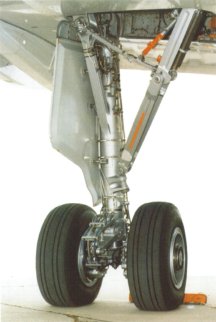
Airbus A340 Landing Gear |
The design environment for PEC was new and challenging. Ultra Electronics was the first UK company to obtain CAA approval to the JAR-21 JB standard. The software environment was a 68332 microprocessor using the XD Ada cross-compiler for on-target testing. Both the development and testing with AdaTEST on the project proceeded to schedule. By August 1996 Ultra Electronics made the first delivery for the Engine Test Cell and in January 1997 PEC was tested on the flying test bed aircraft. PEC was certified in April 1999, the aircraft in June 1999 and both are now in full active service.
AdaTEST has since been ported to the Controls Division DEC Alpha Open VMS host environment and was used for testing the flight critical software of the Landing Gear Control for the Airbus A340-500/600 aircraft. The project has now successfully moved into Rig Testing with Airbus.
Paul Leonard, Test Systems Manager and his team at the Sonar and Communication Systems division on the Submarine Acoustic Warfare Control System (SAWCS) project are also successfully employing AdaTEST. For this Mil Std 00-55 project, Ultra Electronics are using AdaTEST on Windows NT host and x386 target processor with the DACS DDCi host and target compilers.
|
| Easy, flexible, very well supported |
| Peter Devlin explained Ultra's positive views on using AdaTEST: "The Test Case Definition (TCD) system makes it very easy to produce tests". The flexibility to customise AdaTEST also benefited their automated testing approach. Changes were made to the AdaTEST source code to focus results output and to embed test results directly into their automated configuration management system. Peter commented "we were not forced to use AdaTEST in exactly the IPL way". In addition, flexibility over development platforms has been important to Ultra Electronics. Peter noted that the migration of AdaTEST from Vax to DEC Alpha caused no problems to the project, as all tests created on the VAX ran without modification on the Alpha. On the quality and reliability of AdaTEST he said "we have had only two problems in over five years using AdaTEST, both relating to a static analysis metric, neither enough to stop a programme". Peter's highest praise however goes to the support team, "AdaTEST technical support has been excellent, and response times were often within the hour". |
| Confident Outsourcing |
| In 1998 Ultra decided that with the controlled testing environment offered by AdaTEST, they could outsource unit testing maintenance work, and began discussions with the Chinese National Aero-Technology International Supply Corporation (CATIC) as part of their expansion into Chinese markets. By early 2000 CATIC were undertaking code and test maintenance on the PEC project, having purchased AdaTEST under the direction of Ultra Electronics. Peter Devlin summed up AdaTEST benefits for this type of outsourcing as "the AdaTEST script syntax is easy to write, so they don't have to be expert Ada programmers; tests are easily repeatable between sites; our total testing methodology could be outsourced because of AdaTEST's flexibility." |
| Beyond AdaTEST |
| Although AdaTEST is now a central part of the software testing methodology at Ultra Electronics, not all of their software developments are in Ada. They have also successfully used IPL's Cantata++ for testing C++ under Windows NT for the first line test set used with their Digital Automotive System Control Unit (DACSU) for the Challenger Armoured Repair and Response Vehicle (CrARRV), and Challenger 2 battle tank. Ultra Electronics are looking to use AdaTEST, AdaTEST 95 or possibly Cantata later this year on their innovative Hub Integrated Power and Switching System (HIPPS) for generating independent electrical power for propeller ice protection locally in the propeller hub. |
| Conclusions |
| Ultra Electronics knew what they wanted for testing high integrity software. They wanted confidence in the vendor and confidence in the product. Peter Devlin remarked that their customers have been fully satisfied with Ultra's testing approach. Peter concludes "our experience of their use and audits undertaken have borne out our original confidence in IPL's tools". |
| IPL would like to thank Ultra Electronics for permission to report on their experiences with AdaTEST, and take this opportunity to wish them well with the new HIPSS programme and with all other projects. |


